Completing your BTS (Bachelor of Tourism Studies) project can be confusing at first. Many students ask: “Where do I start? How do I choose a topic? What if I make mistakes?” Don’t worry — if you follow a clear step-by-step approach, finishing your project can be smooth and even enjoyable.
This guide covers everything you need, from finding a guide to submitting the final report, including practical tips and topic suggestions. It works for both PTS-1: Indian Culture, Environment, and Tourism and PTS-2: Tourism Marketing.
Step 1: Find a Guide (Supervisor)
Before choosing a topic, the first thing you need is a guide. Your guide acts as your mentor and helps you:
- Pick a suitable project topic
- Review your synopsis
- Provide feedback on your methodology and data collection
- Approve your final project report
Who can be your guide?
- A teacher/faculty in tourism studies or a related field
- A professional with at least 5 years of experience in tourism or hospitality
How to find a guide:
- Contact your Study Centre — they maintain a list of recognized supervisors for BTS projects.
- Choose someone friendly and supportive who can guide you closely.
Tip: Meet your guide early and discuss your ideas — it saves time later.
Step 2: Choose a BTS PTS Project Topic
After you’ve found your guide, the next important step is to choose a project topic. Picking the right topic is crucial because your entire BTS PTS project will revolve around it. To make this easier, we’ve compiled a list of BTS PTS project topic suggestions. You can select any of these ideas or come up with your own, but always discuss your choice with your guide before finalizing. This ensures your topic is practical, achievable, and aligns with your interests and course requirements.
Tips for selecting a topic:
- Pick something you are interested in
- Ensure the topic is practical and achievable
- Check if you can collect data easily
- Make sure the topic relates to your course material
Suggested Topics:
PTS-1 (Indian Culture, Environment, and Tourism):
- Role of Indian Festivals in Cultural Tourism
- Eco-Tourism and Local Communities
- Traditional Art and Handicrafts in Tourism Promotion
- Cultural Heritage of Varanasi: Pilgrim Tourism Study
- Environmental Impact of Trekking Tourism
- Ayurveda and Wellness Tourism in Kerala
- Preservation of Monuments in Delhi
- Influence of Local Cuisine on Tourist Experience
- Tribal Culture and Tourism Development
- Role of River Ganga in Religious Tourism
PTS-2 (Tourism Marketing):
- Marketing Strategies of ITDC
- Social Media in Destination Marketing
- Influencer Marketing for Adventure Tourism
- Customer Satisfaction in the Hotel Industry
- Online Travel Agencies (OTAs) and Marketing
- Branding Rural Tourism in India
- Digital Marketing for Domestic Tourism Post-COVID-19
- Traditional vs. Modern Tourism Marketing Techniques
- Role of Travel Fairs in Tourism Promotion
- Challenges for Small Tour Operators
Step 3: Prepare Your Synopsis / Proposal
The synopsis is like a mini blueprint of your project. It explains what your project is about and how you plan to complete it.
Why it matters:
- Provides a clear plan for your research
- Helps your guide and IGNOU understand your approach
- Keeps you focused and organized
What to include in your synopsis:
- Project Title: Clear and concise
- Objectives: What you aim to achieve
- Rationale: Why this topic is important
- Methodology: How you will collect data (surveys, interviews, observations)
- Area of Study: Where and with whom you will conduct research
- Expected Outcome: What you hope to find or learn
Step 4: Get Synopsis Approved
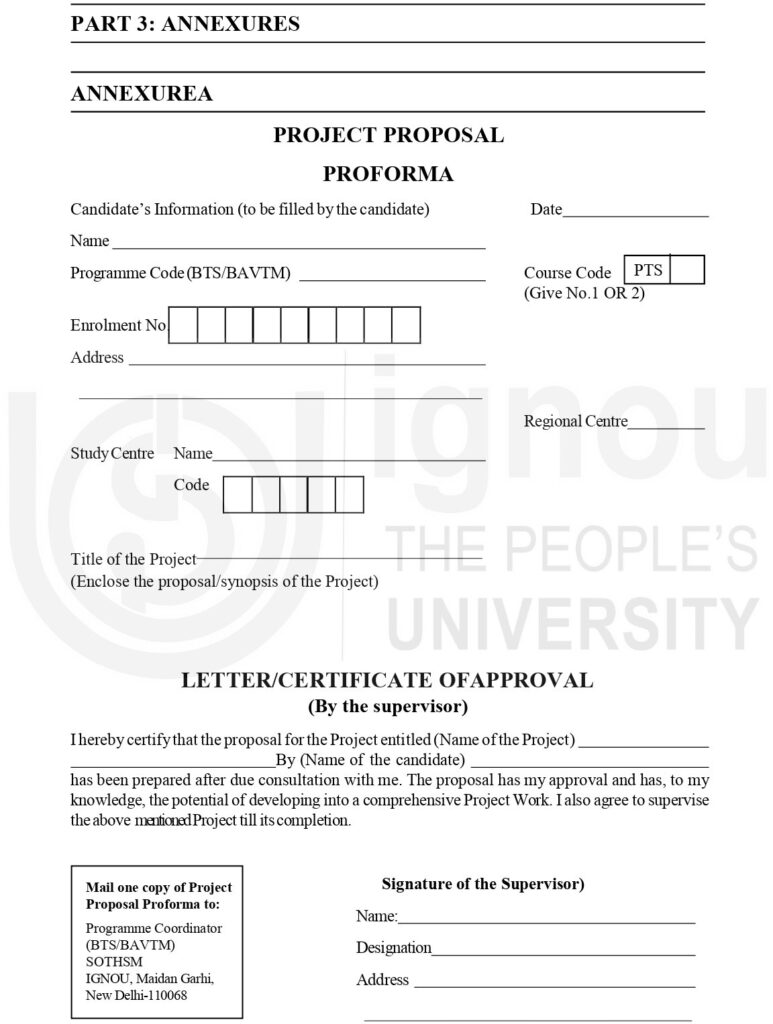
After preparing your project proposal, make two copies and get it approved by your guide, as their approval is final. Ensure it includes your course details, enrollment number, and Study Centre information. Keep a copy for yourself and do not change your topic after approval. Once approved, you can start working actively on your project. Your project cannot start without synopsis approval, so ensure it’s correct and complete. Also ensure to attach Annexure – PROJECT PROPOSAL PROFORMA BTS PTS-1,2. A sample is given below.
Submission Address:
Programme Coordinator (BTS & BAVTM)
School of Tourism and Hospitality Services Management
IGNOU, Maidan Garhi, New Delhi – 110068
Important points:
- Submit via Registered Post
- Do not change your topic after approval
- Keep a copy of the approved synopsis
Step 5: Writing the Final Project Report
Once your synopsis is approved, start collecting data and writing your report. When preparing your final project report, it is recommended to use Times New Roman font, with a readable size like 12 pt for the main text. Your report will typically span around 40–50 pages, depending on the amount of content, data, and illustrations. Make sure to include all the essential sections. Additionally, you can attach appendices, charts, diagrams, or questionnaires if relevant to support your work.
Suggested Report Structure:
- Title Page
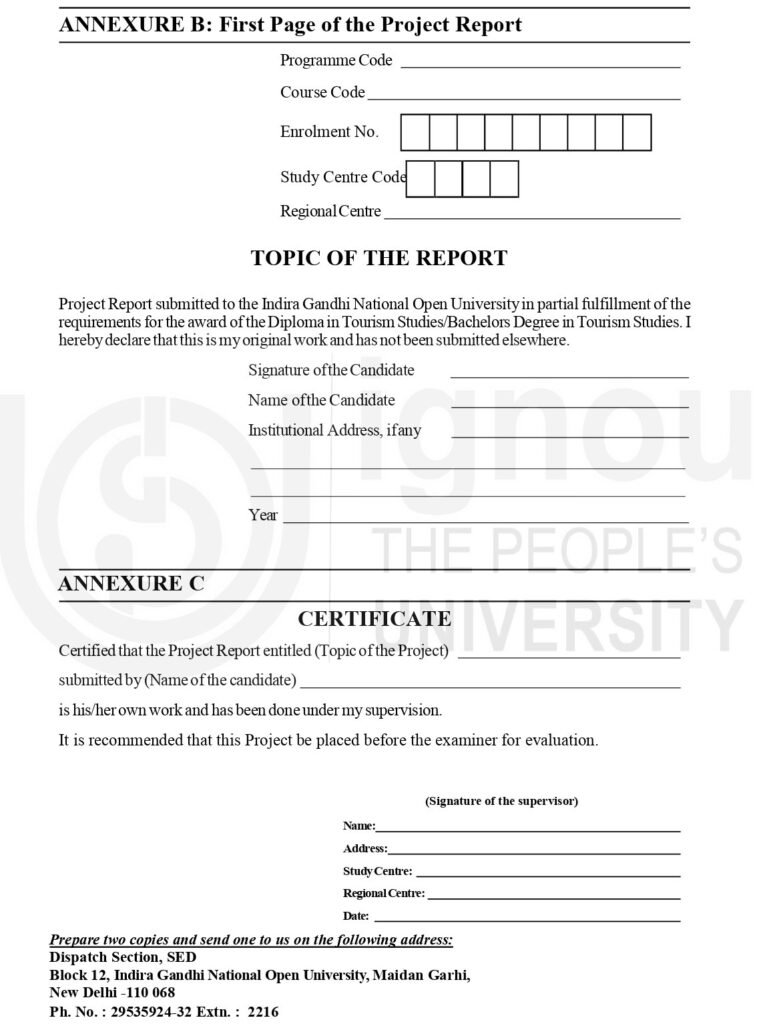
- Annexure B & C: Certificate by Supervisor
- Acknowledgement
- Table of Contents
- Introduction
- Objectives of the Study
- Research Methodology
- Data Collection and Analysis
- Findings and Suggestions
- Conclusion
- Bibliography and Appendix
Step 6: Submission
Submit your final report to:
Programme Coordinator (BTS & BAVTM)
School of Tourism and Hospitality Services Management
IGNOU, Maidan Garhi, New Delhi – 110068
Important points:
- Submit via Registered Post and keep the receipt
- Minimum 40% marks required to pass
- If rejected, you can revise and resubmit
Tip: Always keep a personal copy of your final report.
Conclusion
Completing your BTS PTS project is easier if you follow the right process: The process listed above helps you apply theoretical knowledge, gain practical research experience, and develop essential skills for the tourism industry.
If you are unable to do your project due to a busy schedule or any other reasons we’re here to help! You can WhatsApp us, and our team will guide you to complete an original, well-structured, and submission-ready project, so you can focus on learning without worrying about the process.
FAQs
Q1. What is the difference between PTS-1 and PTS-2?
- PTS-1: Indian Culture, Environment, and Tourism
- PTS-2: Tourism Marketing
Q2. Can I write the project in Hindi?
Yes, IGNOU accepts both English and Hindi.
Q3. How long should the report be?
Around 4000–5000 words
Q4. Who can be my guide?
Faculty member or professional with 5+ years experience
Q5. Can I start the project before synopsis approval?
No, synopsis approval is mandatory
Q6. Where should I submit my project?
Programme Coordinator (BTS & BAVTM), IGNOU, Maidan Garhi, New Delhi
Q7. What if my project is rejected?
You can revise and resubmit
Q8. How many marks do I need to pass?
Minimum 40% (Grade D)
Q9. Can I include tables or charts in the project?
Yes, illustrations are encouraged if relevant
Q10. Can you help me complete my BTS project?
Yes, we provide complete guidance from topic selection to submission